

E2 visa employees are the workers who can enter the United States in E-2 status to work for a treaty investor’s business, and only some of your staff will ever need that status. Most hires are ordinary U.S. workers. This guide explains who counts as an E-2 employee, what executive, supervisory and essential mean and how the registration and the visa application work for Mexican business owners.

Who are E2 visa employees?
E2 visa employees are workers of the same nationality as the investor’s treaty country who come to the United States to work as executives, supervisors or employees with essential skills. USCIS sets these roles and expects the business to show why each one is needed.
The investor is the main applicant. Employees are a separate group that can be added when the business needs people from the treaty country. For a Mexican-owned business, that means Mexican nationals, since the employer and the employee must have the same nationality.
The Foreign Affairs Manual adds that, if the employer does not reside outside the United States, the employer must be maintaining E status in the United States. It also states that a treaty national who holds U.S. permanent resident status cannot bring in employees under the E visa.
Two roles that qualify: executive or supervisory and essential
There are two ways to qualify as one of the E2 visa employees: by holding an executive or supervisory position, or by having special qualifications that make your services essential to the efficient operation of the business. Language and culture alone do not qualify.
USCIS explains that an executive or supervisory employee has ultimate control and responsibility for the overall operation of the enterprise or a major component of it. A person in a lesser role must have special qualifications that make the services essential. USCIS adds that knowledge of a foreign language and culture alone does not qualify.
- Executive or supervisory: title, place in the organization, duties and responsibility for the operation or a major part of it.
- Essential: specialized skills that the business needs and the employee has.
- Not enough on its own: speaking Spanish or knowing the Mexican market.
How an officer judges executive and supervisory E2 visa employees
For E2 visa employees in management, the consular officer looks at the role itself. The Foreign Affairs Manual lists the factors: the title, its place in the organizational structure, the duties, the degree of control and responsibility, the number and skill level of the employees supervised, the pay and the applicant’s experience.
The executive or supervisory element must be a principal and primary function, not an incidental one. If the position mainly requires management skills or key supervision of a large part of the operation, an E classification would generally be appropriate. If it chiefly involves routine work with some supervision of low-level staff, it would not.
The manual also warns that a title alone does not settle the question. A title such as manager or vice president means more in a large operation with many employees than in a small two-person office. For small businesses, describe what the person actually does each week.
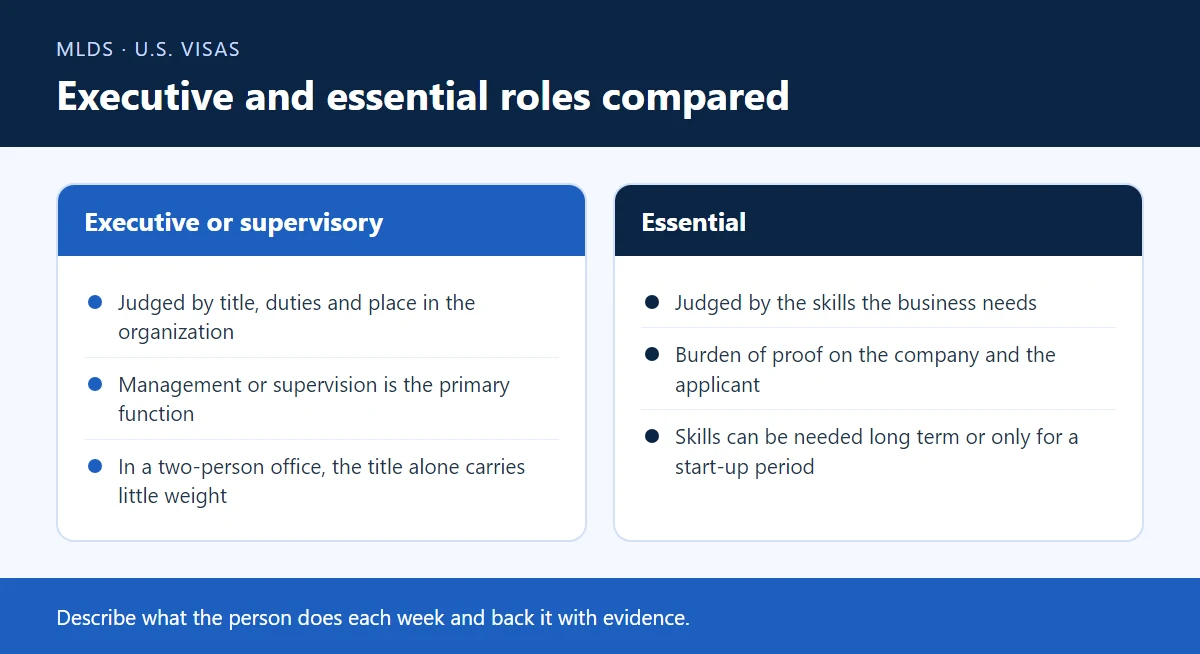
What makes an E2 visa employee essential
Among E2 visa employees, an essential employee has specialized skills that the business needs, and the burden of proof falls on the company and the applicant. The Foreign Affairs Manual says essentiality cannot be decided by a bright-line test and must be assessed on the facts of each case.
When it evaluates specialized skills, the manual lists factors: the experience and training needed to achieve the skill, its uniqueness, the availability of U.S. workers with those skills, the salary such expertise can command, the proven expertise of the applicant and the function of the job. Documents such as letters from chambers of commerce or industry sources can help.
Ordinarily skilled workers can qualify in some cases, mostly in start-up or training situations. A new business may need people who know the overseas operation, and their essentiality comes from familiarity with how the employer works rather than from rare skills. They may need the status only for a short time.
- Long-term need: a skill the business needs on an ongoing basis, such as product development, quality control or a service otherwise unavailable.
- Short-term need: a start-up or training role, for example one or two years to train staff.
- Applicant’s burden: the applicant must show the skills and for how long they are needed, at the first application and at each later one.
Previous employment with the company is not required, except for the case of ordinarily skilled workers who rely on familiarity with the overseas operation. A business can bring in skills it does not yet have on its payroll.
Registration, forms and how E2 visa employees apply
E2 visa employees apply at a U.S. consulate or, if they are already in the United States in lawful status, through a change of status filed by the employer. For the consular route, essential employees and managers submit Form DS-156-E together with the DS-160.
The Foreign Affairs Manual notes that E-2 investors and their derivatives do not need the DS-156-E, while all E-2 essential employees and managers do. USCIS adds that an employer may file Form I-129 on behalf of an employee who is in lawful status, and that Form I-129 cannot be used from outside the country.
Some consulates also keep an E-visa company registration program for businesses that have already been found to meet the standards. The manual says there is no minimum number of employees in E status for a company to be accepted into a registration program, and that registrations should be reviewed at least every five years. The manual says such programs can add efficiency to later applications from the same company.
- Step 1: confirm that the employee has the same nationality as the treaty-country owner.
- Step 2: define the role as executive, supervisory or essential, with a written description.
- Step 3: gather proof: organization chart, job description, resume and evidence of the skills.
- Step 4: complete the DS-160 and the DS-156-E for the employee and apply at the consulate.
- Step 5: keep the business records current, because the company is reviewed too.
Hiring plans, payroll and the investor’s file
The employees you list in your plan are part of the investor’s file, and they need to match the business. The number of E2 visa employees should follow the business model, since USCIS does not publish a fixed headcount for the E-2.
The Foreign Affairs Manual lists payroll records among the evidence that a new business may show for marginality: a payroll register, records of salaries paid, employee data with names and rates of pay and copies of tax forms. A staffing table that agrees with the revenue forecast supports the case. Describe each planned role with a title, duties, start month and salary, so the table can be checked against the application. Our guide to the E2 visa business plan shows how to build it.
Keep two groups apart in your planning: the U.S. workers you hire for ordinary roles, and the E2 visa employees who need status. Both can appear in the payroll, but only the second group goes through an E visa process.
Common mistakes with E2 visa employees
The most common mistakes in E2 visa employees cases are assuming any Mexican hire qualifies, describing a routine job as executive, listing skills that U.S. workers could easily provide and forgetting that the employee’s nationality must match the owner’s.
- Wrong nationality: the employee does not hold the nationality of the treaty-country owner.
- Title only: a manager title with duties that are routine and no real supervision.
- Unproven skills: essential claims with no evidence of training or experience.
- No end date: a start-up role presented as permanent when it only supports the first years.
- Mismatch with the plan: payroll and roles in the plan that do not agree with the application.
Frequently asked questions about E2 visa employees
Can any Mexican worker become one of the E2 visa employees?
No. The worker must have the same nationality as the treaty-country owner and must be an executive, a supervisor or an employee with essential skills. Knowing Spanish or the Mexican market alone does not qualify.
Do E2 visa employees need a degree?
The sources we reviewed do not set a degree requirement. The test is the executive or supervisory role, or specialized skills that the business needs and the applicant has. Evidence of experience and training is what matters.
Can the family of E2 visa employees come along?
USCIS identifies spouses and unmarried children under 21 as eligible dependents of E-2 principals. Ask the consulate or your representative how that applies to an employee’s family before you plan the move.
How many E2 visa employees can a business have?
There is no fixed number in the sources we reviewed. The number should fit the size and model of the business, and the file should explain why each role is needed.
How MLDS supports your E-2 team
MLDS organizes the Mexican documents for the owner and for the employees: civil records, translations, apostilles and powers of attorney, and keeps the file consistent. We coordinate with an allied immigration attorney who reviews each case. We are a document-services firm that works with allied attorneys and do not promise approval.
Start with the E2 visa requirements for Mexican citizens and then contact MLDS with your staffing plan.
Sources: USCIS, E-2 Treaty Investors; U.S. Department of State, 9 FAM 402.9, sections 402.9-7 and 402.9-4 and Treaty Trader and Treaty Investor visas.
Sigue leyendo: E2 visa requirements for Mexican citizens · E2 visa business plan